
Editorial Fisacorp
Condominiums in Brazil with in-house private security services already authorized by the Federal Police fall within the adaptation period under Article 60 of Law No. 14,967/2024 and Article 73(I) of Decree No. 13,012/2026, until September 2027, subject to specific deadlines. This does not permit unauthorized private security operations or require an unarmed front desk to become a security service. The topic returned to the news on November 10, 2026, in Radioagência Nacional. A few days earlier, the STJ examined a front-desk access-control failure. The practical question is who does what at the building entrance and how it is recorded.
What the law says
The Statute, regulated by Decree No. 13,012/2026 of June 9, separates two activities:
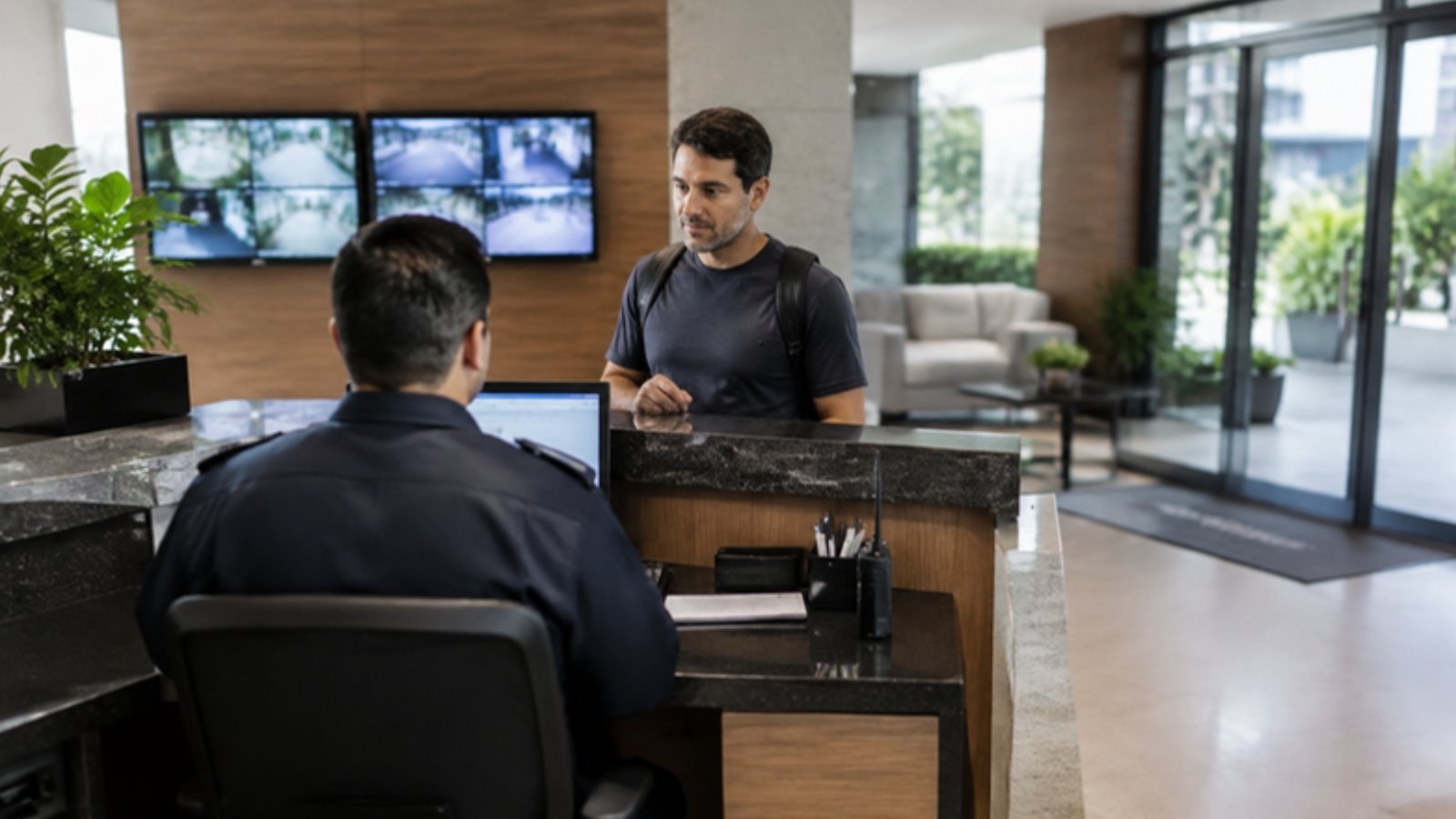
- Front desk: under Article 25, § 5, of Law No. 14,967/2024, controlling the access of people and vehicles at condominium entrances is a typical front-desk service, provided no firearms are used.
- Security guarding: protecting property as a private security service requires a licensed security guard and a company authorized by the Federal Police.
- In-house security: a condominium may set up its own (in-house) security service, with its own staff and for its own use only, but it needs prior authorization from the Federal Police and a security certificate, renewed every two years after inspection, according to Articles 38 and 39 of the decree.
Deadline and penalties
The period of up to three years in Article 60, counted from publication in September 2024, must be read together with Article 73(I) of the decree: it covers providers and in-house services of companies and condominiums already duly authorized by the Federal Police, subject to specific deadlines. It is not permission to start or maintain unauthorized operations until 2027. Article 64 provides for fines of R$1,000 to R$10,000 for individuals and R$10,000 to R$30,000 for legal entities that organize or hire unauthorized private security, as well as closure of the activity, subject to the applicable administrative proceedings. Article 72 addresses IPCA adjustment of other expressly listed fines; it is not applied indiscriminately here to Article 64 amounts.
In the Radioagência Nacional report, labor lawyer Carel Nobre says that combining access control, package receipt and patrols becomes irregular, and that the building manager (síndico) may be held liable for tolerating job-role deviations. A guide from SíndicoNet adds that the role is defined by the actual activity, not by the name used in the contract, and that such deviations can lead to labor lawsuits.
The STJ ruling
In a news release dated November 6, the STJ reported that its Third Panel upheld the ruling against a condominium in Rio de Janeiro (REsp 2,264,505). A front-desk employee let people in without the residents' authorization, and the residents' apartment was burglarized while they were traveling. The damages awarded total R$24,000 for moral damages and R$12,000 for material damages.
The court noted that, as a rule, a condominium is not liable for thefts, but it must use the means available to prevent them. According to the rapporteur, Justice Nancy Andrighi, the employee's conduct must be assessed "in light of the concrete elements" of each case, such as the flow of people, short-term rentals and access-control equipment.
What building managers should do now
- Map each post: write down what doormen, caretakers and security guards actually do, shift by shift.
- Separate the roles in work orders and contracts, with legal support.
- Check the outsourced provider: ask for its Federal Police authorization and the guards' licenses.
- Assess the in-house service: check current Federal Police authorization. The transition does not waive prior authorization; seek advice and regularization promptly if there are irregularities, rather than waiting until 2027.
- Formalize visitor approval: define how residents authorize each entry and record who approved it and when.
- Take the topic to the owners' meeting, with costs and alternatives, before 2027.
Where technology helps
Separating roles and proving that each entry was authorized depend on clear processes and records. EnvLiving, Fisacorp's condominium management platform, brings communication, access and information together in one environment, with controlled and verified visitors and delivery records. It does not replace licensed security guards, Federal Police authorization or legal advice, but it helps the front desk follow a standardized, auditable workflow. If you would like to assess this workflow in your condominium, talk to the Fisacorp team.
References
- Radioagência Nacional (Agência Brasil) — Condominiums have until 2027 to separate doorman and security guard roles (Nov. 10, 2026, in Portuguese)
- Law No. 14,967 of September 9, 2024 — Private Security Statute (in Portuguese)
- Decree No. 13,012 of June 9, 2026 (in Portuguese)
- STJ — Condominium must compensate residents for apartment theft after front-desk access-control failure (Nov. 6, 2026, in Portuguese)
- SíndicoNet — Private Security Statute: what changes for condominiums (in Portuguese)
Sources consulted on November 11, 2026.